Stone Insights
Anti-Slip Sealer for Natural Stone: Safety Without Losing the Look
A practical specification guide for wet-area stone floors, pool decks and commercial circulation zones.
By Xiamen Sun Young Corp Editorial Team · 11 min read
Key Takeaways
- A wet-area stone specification should match material, finish, drainage, maintenance and the relevant slip-test method—not rely on a treatment name alone.
- R ratings, DCOF and barefoot wet-area methods answer different questions; request the test method, sample condition and project-use context together.
- Anti-slip treatment may change sheen, tone, cleanability or surface feel. Approve a full-size control sample before site-wide application.
- Sun Young can coordinate stone, finish and treatment-package discussions for project teams, while the selected system manufacturer and project professionals confirm compatibility, test evidence and local compliance.
Why wet-area stone needs a system decision
A stone floor performs as a system. The natural stone, finish, profile, joint pattern, slope, drainage, grout or jointing material, cleaning programme, contamination risk and expected footwear all contribute to the in-service result. A surface that is appropriate in a dry hotel lobby may not be appropriate at a pool edge, in a shower approach or on a rain-exposed terrace. Conversely, a texture selected for high wet traction can be visually or maintenance-wise unsuitable for a refined indoor reception floor.
This is why a generic instruction such as ‘apply an anti-slip sealer’ is incomplete. It does not identify the stone, whether the surface is polished, honed, flamed, brushed, bush-hammered, sandblasted, split-faced or otherwise textured, or whether the treatment has been reviewed against the finished sample. It also does not define the use case. A pool deck used by barefoot guests is a different environment from a commercial ramp used with shoes, even if both appear wet.
For project teams, the first task is to write a concise performance brief. Identify the area, whether it is internal or external, expected wetting, potential residues such as oils or sunscreen, traffic volume, footwear or barefoot use, cleaning regime, design expectations and the governing local requirement. This brief creates a testable basis for choosing a finish and, if suitable, a compatible treatment system.
What an anti-slip treatment can—and cannot—do
An anti-slip treatment is not a single category of chemistry or performance. Depending on the product and substrate, it may work by modifying the micro-texture of the exposed surface, depositing a coating, increasing surface texture or creating a different maintenance layer. Some systems are designed for particular mineral surfaces; others are not appropriate for calcareous stones, highly polished surfaces, resin-treated materials or certain coatings. Product technical data, application instructions and compatibility advice should therefore be reviewed for the exact selected stone and finish.
A treatment can be useful when it is part of a coordinated system, but it should not be described as making every stone permanently safe. Results can vary with the initial finish, application rate, dwell time, rinsing or neutralisation steps where applicable, curing conditions, wear, contaminants and cleaning products. A treatment may also affect visual depth, gloss, colour perception, cleanability or tactile feel. For that reason, the project should require a control sample or mock-up that shows the approved material, finish, treatment, joint treatment and realistic wetting condition.
The mock-up is the decision point where commercial and aesthetic questions become visible. The design team can review whether a honed marble still has the desired softness, whether a textured limestone remains easy to maintain and whether a pool-deck paver has the required appearance. The contractor can establish application sequencing, protection and cure windows. The treatment supplier can confirm which preparation and maintenance products are compatible. If the project needs a documented result, the laboratory or test provider should test the selected, treated sample under the applicable method rather than an unrelated reference tile.
Start with finish selection, not chemistry
Finish choice should be made before treatment selection. A polished stone is typically chosen for reflection and colour depth, while a honed finish reduces visible reflection and can be easier to position in many interior circulation areas. Brushed, flamed, bush-hammered, sandblasted, tumbled and naturally split surfaces introduce different texture profiles, visual movement and cleaning demands. None of these terms is a universal slip rating. They describe a surface treatment or appearance; the project still needs a relevant performance discussion and, when required, testing of the actual sample.
For a lobby or dry retail floor, a tightly controlled honed surface may provide the intended visual language. For a shower room, spa approach, external entry, landscaped walkway or pool deck, a more textured finish may be more appropriate, subject to the stone's fabrication feasibility and the design brief. The decision is not only about traction. Sharp or aggressive profiles can be uncomfortable barefoot, harder to clean or inconsistent at edges. Very open texture can retain dirt or cleaning residues. The best fit is therefore a balance between user condition, design intent, drainage and maintenance capacity.
When the same stone continues from an interior space to a wet exterior, use a coordinated finish schedule rather than treating the entire project as one surface. The stone colour and selection can stay visually coherent while the finish is adapted by zone. This helps design teams preserve material continuity without applying one assumed performance level to every location.
Match the natural stone to the environment
Natural stone selection begins with the use environment. Marble and limestone can be specified successfully in many interior and protected applications, but because they are calcareous materials, compatibility with acidic cleaning chemicals and some treatment chemistries must be checked. Granite and some quartzites may be considered where a harder, often more weather-tolerant stone is sought, but their suitability still depends on the particular material, finish and project conditions. Travertine, sandstone and open-textured limestones can require additional detailing for filling, drainage, cleaning and edge design.
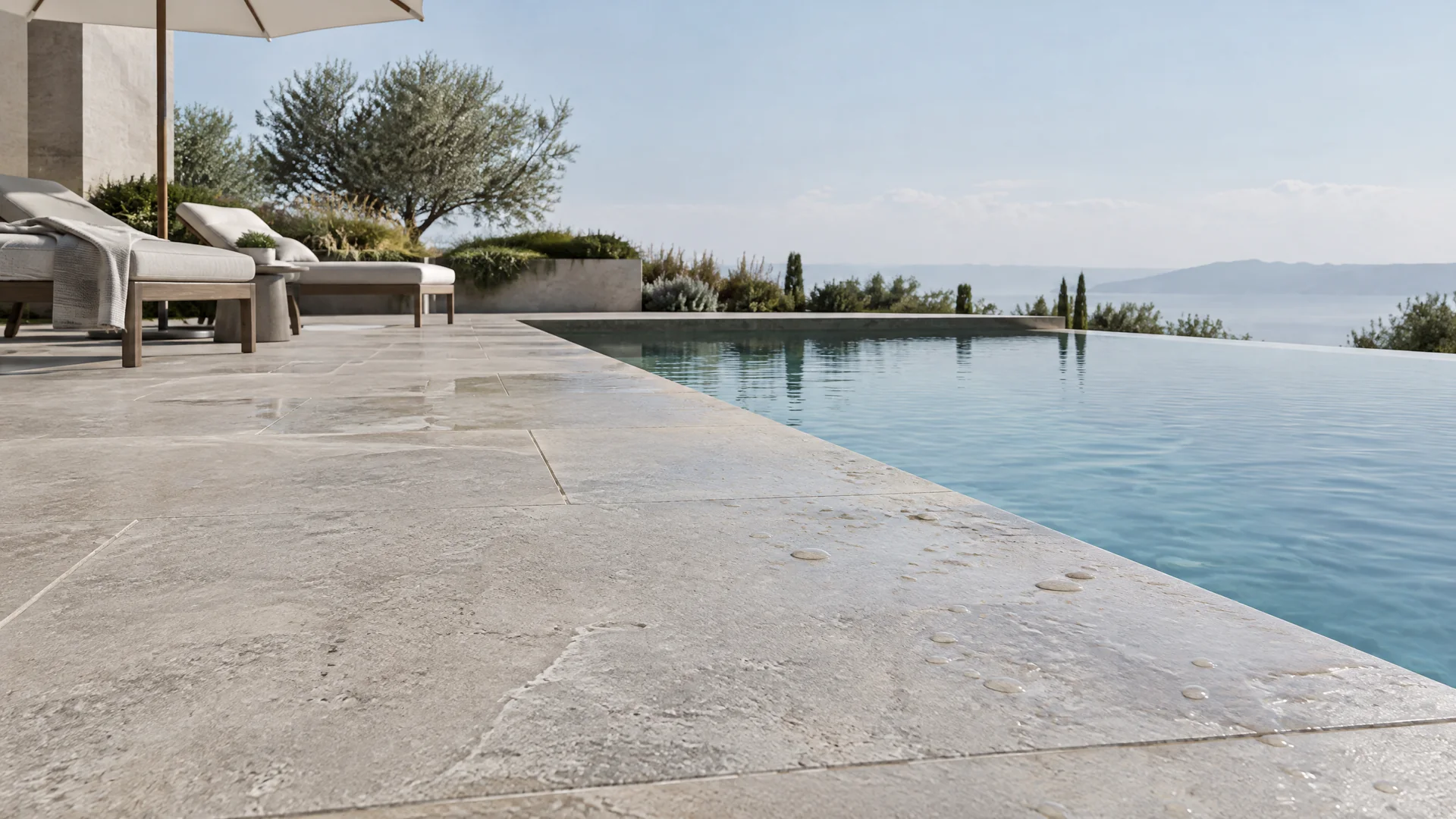
For pool decks and rain-exposed exterior circulation, confirm the stone's fabrication thickness, edge treatment, intended finish, installation system, slope and drainage detail together. Standing water is a design and installation question as well as a surface question. A material test result does not correct an area with poor falls, blocked drainage or a cleaning process that leaves residue. In coastal, resort and high-traffic locations, the project brief should also state expected contaminants, such as chlorinated water, sunscreen, sand or food-service oils, because these affect maintenance planning and the test scenario a consultant may require.
For commercial interiors, identify whether the primary concern is occasional tracked-in water, frequent wet cleaning, food-service residues, accessibility requirements or a specific authority standard. This avoids applying an exterior-grade texture to a refined reception area without need, or specifying a beautiful dense finish in a wet circulation zone without a verification plan.
Understand R ratings, DCOF and barefoot zones
Slip-resistance language is often copied from one market to another without explaining the test condition. That creates risk. An R rating is associated with the former DIN 51130 ramp method, which uses standard footwear and oil as the contaminant. It is a method-specific classification, not a universal statement that a surface is safe in water, for bare feet or in every jurisdiction. The UK Slip Resistance Group notes that the former DIN 51130 R categories ranged from R9 to R13 and that the DIN 51097 method addressed wet barefoot areas using A, B and C categories; it also notes that these methods have been superseded by EN 16165 in its current overview.
ANSI A326.3 is another relevant reference. The Tile Council of North America describes it as a test method for measuring Dynamic Coefficient of Friction (DCOF) of hard-surface flooring materials in the laboratory and field. A DCOF result, an R classification and a pendulum result should not be treated as interchangeable numbers. They may use different equipment, contaminants, footwear or surface conditions. The governing project document, local code, authority, insurer or design consultant should state which method and acceptance criteria apply.
For barefoot wet areas, do not assume that a shod-foot R rating answers the correct question. Ask the project team to identify the relevant wet barefoot test context and local requirement. For natural-stone modular tiles, European requirements and national implementation may lead specifiers to different documents or verification methods. The practical rule is simple: match the test method to the actual use, then test the actual approved finish and treatment condition if the project requires evidence.
A pre-approval workflow for treatment projects
A disciplined workflow protects design quality and reduces late changes. First, issue representative stone samples that show the variation, intended finish and edge treatment. Second, ask the proposed treatment supplier to confirm substrate compatibility in writing, including preparation, application steps, cure time, visual effects, cleaning restrictions and maintenance instructions. Third, prepare a full-size mock-up with the selected stone, treatment, joints and, where useful, the planned drainage or slope detail. Fourth, arrange the appropriate verification requested by the project. Finally, document the approved sample as the benchmark for fabrication, installation and handover.
This workflow is especially important when a polished or honed natural stone is being considered for a wet area. Treatments can be technically possible but visually unacceptable, or visually subtle but incompatible with the cleaning programme. A small coupon can reveal compatibility, while a larger mock-up makes appearance, water flow, barefoot comfort, joint design and maintenance access easier to review. If a treatment supplier offers an R rating, DCOF, pendulum value or other data, record the exact test standard, condition, date, sample identity and whether the result applies before or after the selected treatment.
The approval record should also identify responsibility boundaries. The stone supplier can provide material and finish information. The treatment manufacturer is responsible for its product documentation and application instructions. The installer is responsible for following the approved system and site conditions. The architect, specialist consultant and local authority determine the relevant design and compliance requirements. Clear allocation prevents a general material description from being misread as an engineering certification.
Maintenance is part of the safety strategy
A good surface selection can be compromised by unsuitable maintenance. Residues from cleaners, soaps, oils, waxes, polishes or poorly rinsed products can change how a floor behaves when wet. Routine cleaning should follow the approved stone and treatment manufacturer guidance, especially for calcareous stones and chemically treated surfaces. Abrasive pads, acidic products and high-gloss maintenance coatings should never be assumed compatible merely because they were used elsewhere on the project.
At handover, the owner should receive a simple maintenance plan: acceptable cleaning products, dilution and rinse requirements, frequency, inspection points, what to do after staining or contamination, and when to seek supplier advice. In high-traffic wet areas, a periodic review is more useful than an unsupported claim that the surface will remain unchanged indefinitely. Where the project has a documented slip-resistance requirement, the maintenance and review plan should be coordinated with the responsible designer or facility manager.
Questions to ask before selecting a system
Before issuing a purchase order or treatment instruction, ask: What is the exact stone and finish? Is the area dry, intermittently wet or continuously wet? Will it be used with shoes, bare feet or both? What contaminants are likely? What test method does the governing requirement call for? Does the proposed treatment supplier confirm compatibility with this stone and finish? What does the treated control sample look and feel like? What cure, protection and maintenance instructions apply? Who will verify site application and manage the handover record?
These questions are not paperwork for its own sake. They help a project team avoid an expensive mismatch between design intent, surface selection and actual operating conditions. They also create a clearer request for quotations, samples and technical support.
Scope of Sun Young support
Sun Young supports international stone project teams with material selection, finish discussions, sample coordination, cut-to-size fabrication dialogue and export-oriented project communication. For anti-slip work, the most useful starting package is the application brief, stone preference, required finish, drawings or area schedule, environmental exposure, expected traffic and any named standard or test requirement. This allows the stone, finish and treatment discussion to begin on a defined basis.
Sun Young does not represent this guide as a project-specific safety certificate, a test report or a substitute for local code review. Where a project needs evidence, the selected system manufacturer, laboratory, architect, safety consultant and installer should be engaged to confirm the relevant method, sample condition and acceptance criteria.
Conclusion
Natural stone can serve wet and high-traffic areas without giving up a refined material character, but the specification must be more precise than a generic anti-slip claim. Start with the real use conditions. Select the stone and finish by zone. Check treatment compatibility on the chosen sample. Match any test method to the actual footwear, contaminant and wetting condition. Then protect the result with installation control and a maintenance plan. This approach gives project teams a defensible path to balance design intent, technical clarity and long-term operational care.
Frequently Asked Questions
What is anti-slip sealer for natural stone?
The term can describe different treatment systems intended to change traction or surface behaviour on a specific stone finish. It is not one universal product or a universal safety guarantee. The stone, finish, application conditions, appearance target, cleaning method and required test context must be reviewed together.
Can anti-slip treatment be used on marble?
It may be possible with a system specifically confirmed for the selected marble and finish, but compatibility should never be assumed. Review the treatment manufacturer's technical data and prepare an approved control sample because appearance, sheen, cleanability and surface feel may change.
Does an R rating prove that stone is safe around a pool?
No. An R rating is associated with a particular shod-foot, oil-contaminated ramp-test context. Pool decks may involve water, barefoot users, sunscreen and local requirements. The project team should identify the applicable method for the actual use condition rather than relying on an R rating alone.
What should be tested before an anti-slip treatment is approved?
Use a representative sample or mock-up with the exact stone, finish, treatment, joints and intended visual condition. If the project requires documented performance, request the applicable test method and test the approved sample condition through the responsible manufacturer, laboratory or consultant.
Will anti-slip treatment change the colour or gloss of natural stone?
It can. The direction and extent depend on the stone, existing finish and system selected. A full-size control sample should be reviewed under realistic light and wet conditions before site-wide work is approved.
How should treated natural stone be maintained?
Follow the approved stone and treatment manufacturer's cleaning guidance. The handover plan should identify compatible products, dilution and rinsing steps, inspection points and restrictions on acidic, abrasive or gloss-building products where relevant.
Topics: Natural Stone Safety, Anti-Slip Sealer, Pool Deck Stone, Wet-Area Flooring, Commercial Stone Flooring