Stone Insights
Calacatta vs Carrara Marble: What's the Difference? A Complete Comparison
Origin, Veining, Price & Best Applications for Both Italian Marbles
By Xiamen Sun Young Editorial Team · 8 min read
Key Takeaways
**Key Takeaways:** Calacatta and Carrara marble both come from the Apuan Alps in Tuscany, Italy, but they differ significantly in veining, color, and price. Calacatta features bold, dramatic gold or gray veining on a warm white background and is 2-3x more expensive ($120-$300/sqft) due to limited quarry yield. Carrara has soft, feathery gray veining on a cooler gray-white background and is the most affordable Italian marble ($40-$90/sqft). Choose Calacatta for statement luxury kitchens, Carrara for full-room elegance on a budget, and Statuario for premium projects requiring book-matched slabs.
---
Calacatta vs Carrara marble is one of the most common questions our team fields from architects, designers, and homeowners. Both are premium Italian marbles with over 2,000 years of history, both come from the same mountain range in Tuscany, and both command premium prices relative to engineered alternatives. Yet they produce strikingly different visual results — and choosing between them changes the entire aesthetic of a kitchen, bathroom, or feature wall.
After 24 years of exporting Italian marble to 40+ countries, we've helped thousands of clients make this decision. This guide breaks down the actual differences in plain language — no jargon, no marketing fluff — so you can choose with confidence for your specific project.
- **What you'll learn in this guide:**
- Where Calacatta and Carrara marble are actually quarried (same mountain!)
- The 4 key visual differences in veining, color, and pattern
- Real 2026 pricing for both varieties (and what drives cost)
- Which variety is best for kitchens, bathrooms, and feature walls
- How Statuario fits into the Calacatta-Carrara spectrum
- A practical decision framework for choosing between them
*Origin, Veining, Price & Best Applications for Both Italian Marbles*
Where Are Calacatta and Carrara Marble Quarried?
Here's a detail most people don't realize: Calacatta and Carrara marble come from the **same mountain range** — the Apuan Alps in Tuscany, northwestern Italy. The town of Carrara sits at the base of these mountains, and the quarries extend up to elevations of 1,500 meters.
Despite sharing a geological origin, the two varieties are extracted from different specific quarries and have different visual characteristics due to variations in mineral composition, geological pressure, and vein formation.
Carrara Marble Quarries
- **Location:** Approximately 90+ active quarries in the central and western Apuan Alps
- **Total production:** Approximately 1.5 million tons annually — the world's largest marble production region
- **Quarrying history:** Active since the Roman era (2,000+ years)
- **Famous quarries:** Fantiscritti, Ravaccione, Bettogli
Carrara marble accounts for the majority of Italian marble export volume, which is why it is more affordable than Calacatta.
Calacatta Marble Quarries
- **Location:** Approximately 30-40 specific quarries, primarily in the eastern Apuan Alps
- **Total production:** Significantly less than Carrara — Calacatta is 10-15x rarer than Carrara
- **Famous varieties:** Calacatta Gold, Calacatta Borghini, Calacatta Vagli, Calacatta Paonazzo
- **Yield:** Often less than 20% of extracted blocks meet the strict Calacatta quality standards — most blocks are downgraded to lower-tier Italian marbles
**Key takeaway:** Both marbles come from the same region, but Calacatta is geologically rarer and quarried with stricter quality control, which directly drives the 2-3x price premium.
For a deeper dive into the quarrying process and the journey from mountain to slab, see our guide: **[Inside Italy's Carrara Marble Quarries: A Journey from Mountain to Slab](/products/inside-carrara-italy-marble-quarries/)**.
Calacatta vs Carrara: Visual Differences Explained
The visual differences between Calacatta and Carrara are what most buyers notice first. Here's a side-by-side breakdown.
Comparison Table
| Property | Calacatta Marble | Carrara Marble |
|---------|------------------|----------------|
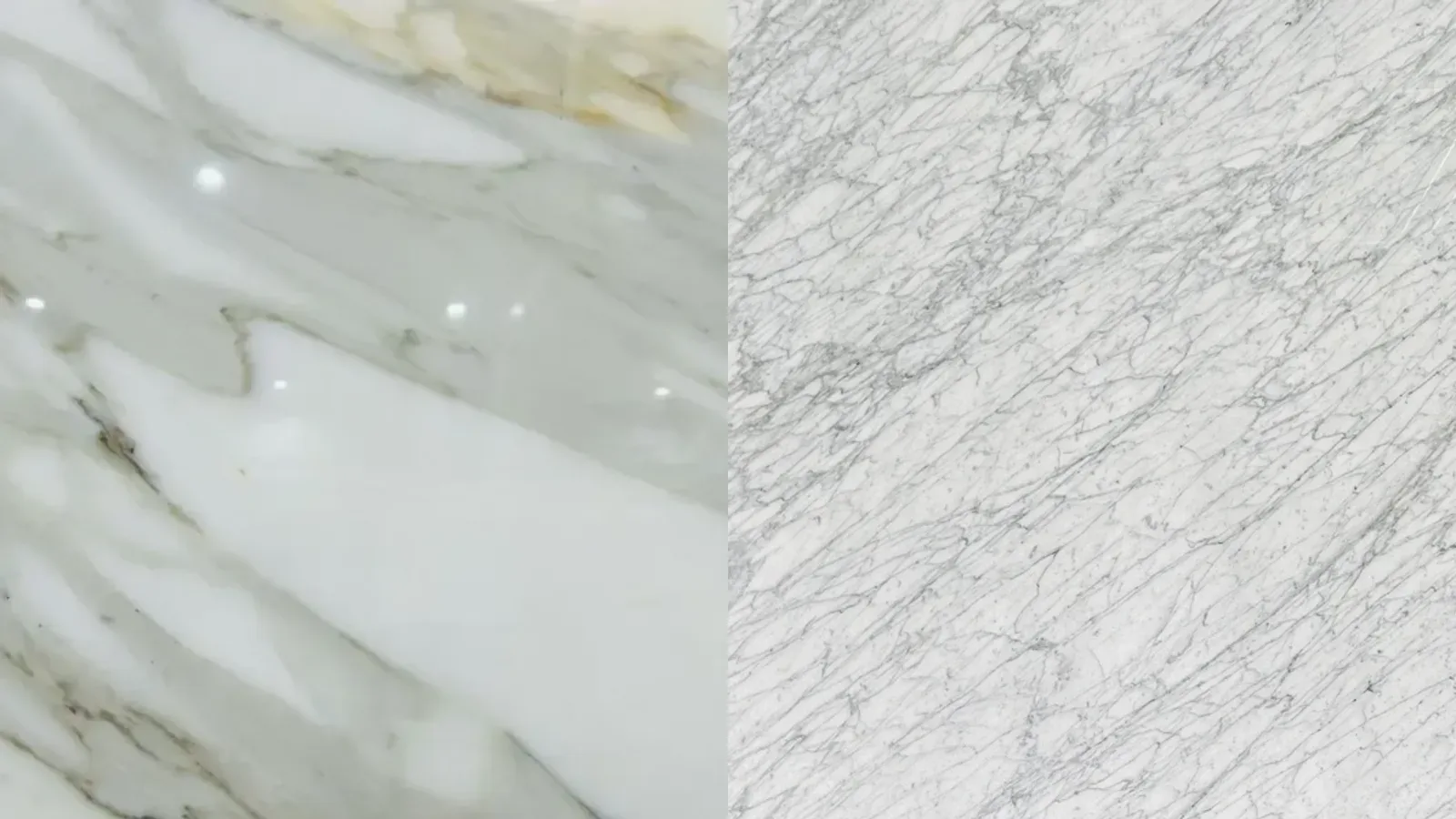
| **Base color** | Warm white to creamy | Cool grayish white |
| **Veining color** | Bold gold, amber, or dark gray | Soft, feathery gray |
| **Veining pattern** | Dramatic, sparse, thick veins | Dense, soft, web-like |
| **Pattern consistency** | High variation between slabs | More consistent |
| **Visual impact** | Statement, focal point | Background, full-room |
| **Background brightness** | Warmer, more luminous | Cooler, more uniform |
| **Vein-to-background ratio** | 30-40% veins, 60-70% background | 50-60% veins, 40-50% background |
Calacatta Marble Visual Characteristics
[Calacatta Gold Marble](/products/calacatta-gold-marble/) is the most recognizable Calacatta variety, with bold gold and amber veining on a warm white background. The veins are typically thick (3-15mm), sparse (large sections of clean white), and dramatic. Each slab is a unique piece — the veining patterns cannot be replicated.
Other Calacatta varieties include Calacatta White (gray veining on bright white), Calacatta Vagli (subtle beige veining), and Calacatta Borghini (heavy gold and amber). All share the bold, dramatic aesthetic that defines Calacatta.
Carrara Marble Visual Characteristics
[Carrara White Marble](/products/carrara-white-marble/) features soft, feathery gray veining on a cool grayish-white background. The veins are typically thin (1-3mm), dense (covering more of the slab surface), and gentle. The overall appearance is softer and more uniform than Calacatta.
Carrara marble is the variety most people picture when they think "Italian marble." It has graced European cathedrals, Renaissance sculptures, and luxury bathrooms for centuries.
How to Tell Them Apart at a Glance
- If you have a slab sample and 10 seconds to decide:
- **Bold, thick, dramatic veins with lots of clean white space** → Calacatta
- **Soft, feathery, dense gray veins throughout** → Carrara
If the veins look like brushstrokes, it's Calacatta. If they look like pencil shading, it's Carrara.
Calacatta vs Carrara: Price Differences
The price difference between Calacatta and Carrara is significant and reflects the rarity, quality control, and aesthetic prestige of each variety.
2026 Slab Pricing (USD per square foot)
| Variety | Price Range | Average | Tier |
|---------|------------|---------|------|
| Calacatta Gold | $150-$300 | $200 | Premium-Luxury |
| Calacatta White | $120-$250 | $175 | Premium-Luxury |
| Calacatta Vagli | $100-$200 | $140 | Premium |
| Statuario / Statuarietto | $100-$200 | $145 | Premium |
| Carrara White (C-grade) | $40-$70 | $55 | Mid-Range |
| Carrara White (CD-grade) | $30-$50 | $40 | Entry |
Why Calacatta Costs 2-3x More Than Carrara
- **Rarity:** Calacatta yield is 10-15x lower than Carrara. Only 1 in 10 quarried blocks meets Calacatta quality standards.
- **Quarry location:** Calacatta quarries are at higher elevations and harder to access, increasing extraction costs.
- **Quality control:** Each Calacatta block is hand-selected by quarry masters with decades of experience. Less-skilled selection would result in lower-tier classification.
- **Aesthetic prestige:** Calacatta has become synonymous with luxury in architectural publications. Designers pay a premium for the prestige value.
- **Limited substitutes:** There is no true substitute for Calacatta — the closest alternatives (Statuario, Calacatta-look quartzite) are themselves premium-priced.
Hidden Costs to Consider
- When budgeting your project, factor in:
- **Fabrication:** Identical cost for both varieties ($25-$40/sqft)
- **Installation:** Identical cost for both varieties ($15-$25/sqft)
- **Sealing at installation:** $200-$400 total
- **Edge profile upgrade:** $15-$40/linear foot for premium edges
- **Bookmatching (Calacatta only):** $50-$100/sqft extra for mirror-matched slabs
**Realistic total installed cost for a 50 sqft Calacatta Gold kitchen:** $8,000-$15,000
**Realistic total installed cost for a 50 sqft Carrara White kitchen:** $2,500-$5,000
Which Is Better for Your Project? A Use-Case Comparison
Beyond aesthetics and price, your project type matters significantly. Here are our recommendations based on 24 years of feedback from architects, designers, and homeowners.
Kitchen Countertops
**Winner: Both work, but for different priorities.**
- **Choose Calacatta** for statement kitchen islands, waterfall edges, and luxury kitchens where the marble is the focal point. Specify honed or leathered finish to hide etching.
- **Choose Carrara** for full-kitchen countertops, secondary surfaces, and kitchens where marble complements rather than dominates the design.
Bathroom Vanity Tops
**Winner: Carrara for budget, Calacatta for luxury.**
Both varieties perform excellently in bathroom settings due to lower exposure to acids and stains. Carrara is the most common choice for residential master bathrooms. Calacatta is preferred for luxury hotel bathrooms and high-end powder rooms.
Feature Walls
**Winner: Calacatta (dramatic veining).**
For statement feature walls, [Calacatta Gold Marble](/products/calacatta-gold-marble/) creates visual impact that Carrara cannot match. The bold veining becomes artwork, especially when book-matched across large surfaces.
Flooring
**Winner: Carrara (cost-effective uniformity).**
For full-room flooring, Carrara's more uniform appearance and lower cost make it the practical choice. Calacatta's dramatic variation can feel overwhelming across large floor areas.
Fireplace Surrounds
**Winner: Calacatta.**
Fireplace surrounds are focal points where dramatic veining shines. Calacatta Gold with a leathered finish creates a memorable, magazine-worthy feature.
Outdoor Applications
**Winner: Neither — choose quartzite or granite.**
Italian marble is not recommended for outdoor kitchens, pool surrounds, or exterior cladding in freeze-thaw climates. The freeze-thaw cycle causes spalling and surface degradation. For outdoor use, consider quartzite or granite alternatives.
What About Statuario Marble? How It Fits In
[Statuarietto White Marble](/products/statuarietto-white-marble/) is often discussed alongside Calacatta and Carrara, but it sits between them in the Italian marble spectrum. Here's how it compares.
Statuario Marble Characteristics
- **Origin:** Apuan Alps, specific quarries near Calacatta sources
- **Base color:** Bright cool white (brighter than Calacatta)
- **Veining:** Bold gray, more uniform than Calacatta
- **Pattern consistency:** Higher than Calacatta — easier to book-match
- **Price:** $100-$200/sqft (premium but less than Calacatta Gold)
- **Best for:** Bookmatched feature walls, large kitchen runs, luxury bathrooms
Where Statuario Fits in the Spectrum
Think of Italian marble selection as a spectrum:
- **Lowest price, most uniform:** Carrara White
- **Middle price, moderate drama:** Statuario / Statuarietto
- **Highest price, most dramatic:** Calacatta Gold / Calacatta White
Statuario is often the best compromise for projects where Calacatta is too expensive but Carrara feels too subtle. It gives you Calacatta-like drama with more pattern consistency and lower cost.
For another dramatic Italian marble option, consider [Calacatta Viola Marble](/products/calacatta-viola-marble/) — a rare variety with purple-gray veining on white background, sourced from the same Apuan Alps quarries.
Making Your Calacatta vs Carrara Decision
The choice between Calacatta and Carrara marble is ultimately about three factors: your design priority (statement vs background), your budget (premium vs mid-range), and your tolerance for variability (high vs low).
- **Choose Calacatta if:**
- You want a dramatic statement focal point
- Budget allows for $150-$300/sqft slab cost
- You appreciate unique, one-of-a-kind slabs
- The application is a focal area (island, feature wall, fireplace)
- **Choose Carrara if:**
- You want elegant Italian marble on a mid-range budget
- The application is full-room or background
- You prefer consistent, subtle veining
- You're new to natural stone and want a forgiving first experience
- **Choose Statuario if:**
- Calacatta is out of budget but you want Calacatta-like drama
- You need book-matched slabs for large surfaces
- You want premium Italian marble with more pattern consistency
Our team at Xiamen Sun Young has been exporting Italian marble to 40+ countries for 24 years. We work directly with quarry partners in the Apuan Alps and can provide current inventory, slab photos, and detailed origin documentation for any variety.
- **Next steps:**
- Review our [Calacatta Gold Marble](/products/calacatta-gold-marble/) and [Carrara White Marble](/products/carrara-white-marble/) product pages for slab photos and pricing
- Request our current Calacatta and Carrara inventory with origin documentation
- Schedule a virtual slab selection session — we'll show you live slabs via video and recommend varieties based on your project requirements
- Ask for sample slabs shipped to your location for hand-selection
*Need help deciding? Our editorial team responds to every project inquiry within 24 hours with personalized recommendations.*
Frequently Asked Questions
Is Calacatta marble more expensive than Carrara?
Yes, Calacatta is 2-3x more expensive than Carrara. Calacatta Gold ranges $150-$300 per square foot, while Carrara White ranges $40-$90 per square foot. The price difference reflects rarity (Calacatta is 10-15x rarer), quarry extraction difficulty, and aesthetic prestige.
Which is better quality — Calacatta or Carrara?
Both are excellent quality Italian marbles. Quality is similar in terms of durability and longevity. The difference is aesthetic — Calacatta has bolder, rarer veining. For structural quality and longevity, both varieties will last 30-50+ years with proper care.
Which marble is better for kitchen countertops?
Both work well for kitchen countertops. Choose Calacatta for statement kitchens where the marble is the focal point (waterfall islands, feature backsplashes). Choose Carrara for full-kitchen countertops, secondary surfaces, or budget-conscious projects. Both should be honed or leathered to minimize etching visibility.
Can you tell the difference between Calacatta and Carrara?
Yes, the difference is visually clear. Calacatta has bold, thick, dramatic veining with large sections of clean white background. Carrara has soft, feathery, dense gray veining throughout. Think brushstrokes vs pencil shading.
Is Calacatta marble worth the extra cost?
It depends on your design priority. Calacatta is worth the premium for statement applications where the marble aesthetic defines the space. Carrara is the better value for projects where marble complements other design elements or for full-room applications where cost-per-square-foot matters.
Where do Calacatta and Carrara marble come from?
Both come from the Apuan Alps in Tuscany, northwestern Italy. The town of Carrara sits at the base of these mountains. Calacatta is quarried from specific high-elevation quarries in the eastern Apuan Alps, while Carrara comes from approximately 90+ quarries throughout the range.
How do I know if I'm buying real Calacatta or fake Calacatta?
Buy from established suppliers who source directly from Italian quarries. Real Calacatta has natural variation between slabs — no two slabs look identical. Fake or look-alike Calacatta (often porcelain or engineered quartz) has repetitive patterns and lower depth. Always request quarry origin documentation and slab photos before purchase.
Topics: calacatta marble, carrara marble, italian marble, marble comparison, stone selection